
The automotive industry is undergoing one of its biggest transformations in decades, and Honda is making major changes to prepare for the future. While many manufacturers have moved aggressively toward fully electric vehicles, Honda is taking a more flexible approach: expanding hybrids in the short term while continuing to develop a new generation of electric vehicles for the years ahead.
By 2030, Honda expects its global lineup to look very different from today, with significantly more hybrid models, a growing range of EVs and new technologies designed to improve efficiency, performance and connectivity.
For popular models such as the Honda CR-V and Honda Accord, electrification is already becoming a major part of the lineup.
Honda’s Electrification Strategy Is Changing
Honda originally set out an ambitious plan to make electric vehicles a much larger part of its global sales by 2030. The company had previously targeted a global EV/FCEV sales ratio of at least 30% by the fiscal year ending March 2031.
However, changing EV market conditions have led Honda to adjust its approach.
In 2025, Honda acknowledged that the global EV market was developing more slowly than previously expected and said its 2030 EV sales ratio would likely fall below its earlier 30% target. Instead, Honda announced that hybrids would play a much larger role during the transition toward widespread EV adoption.
The company’s current strategy places much greater emphasis on hybrid vehicles, while Honda continues to develop its dedicated EV lineup.
This is less of a retreat from electrification and more of a change in timing. Honda continues to view EVs as an important part of its long-term strategy, but hybrids are becoming the practical bridge between traditional gasoline engines and fully electric vehicles.
Honda Plans 15 New Hybrid Models by 2030
One of the biggest changes in Honda’s strategy is the rapid expansion of its hybrid lineup.
Starting in 2027, Honda plans to introduce next-generation hybrid models using a new hybrid system and platform. The company says it plans to launch 15 next-generation hybrid models globally by the end of the fiscal year ending March 2030, with North America expected to be a particularly important market.
Honda also plans to increase hybrid production capabilities throughout North America, including making all of its North American auto plants capable of producing hybrid vehicles.
The company is targeting 2.2 million hybrid vehicle sales by 2030, making HEVs a central part of its business during the transition toward electric mobility.
Honda expects its next-generation hybrid technology to deliver improved efficiency, while also reducing production costs. The company says its next-generation hybrid system is targeted to cost more than 50% less than the system introduced in 2018 and more than 30% less than the system introduced in 2023.
The Honda CR-V Is Already Leading the Hybrid Push
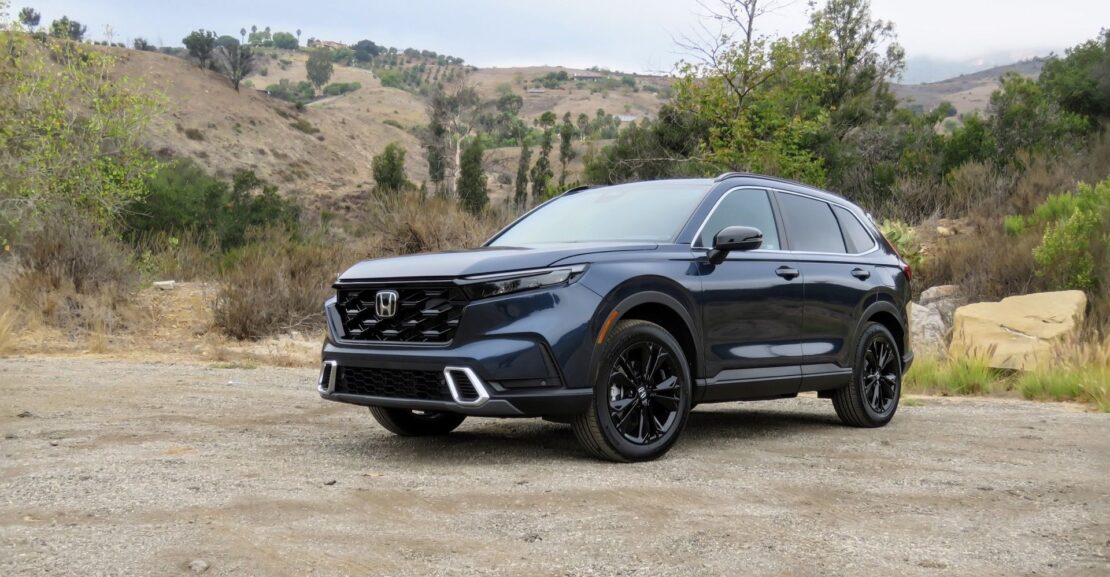
One of the clearest examples of Honda’s electrification strategy is the CR-V.
The CR-V has become one of Honda’s most important hybrid models, combining the practicality of a compact SUV with an efficient gasoline-electric powertrain.
For 2026, the CR-V Hybrid uses Honda’s 204-horsepower two-motor hybrid powertrain, with hybrid versions available across several trims. All-wheel drive is also available, making the CR-V Hybrid a practical option for customers who want lower fuel consumption without giving up SUV capability.
Honda has also expanded the appeal of the hybrid CR-V with versions such as the CR-V TrailSport Hybrid, which combines the hybrid powertrain with all-terrain tires and additional capability-focused equipment.
The latest CR-V demonstrates why hybrids remain so important for Honda. Customers can reduce fuel consumption and emissions without having to depend entirely on public charging infrastructure or change the way they refuel.
In markets where charging infrastructure is still developing, this can make hybrids particularly attractive.
The Accord Is Becoming More Electrified Too
The Honda Accord is another major example of the company’s hybrid strategy.
The 2026 Accord Hybrid uses a 204-horsepower hybrid powertrain, with the hybrid system standard on Sport Hybrid and higher trims. Honda combines the electric motor’s instant torque with a gasoline engine to deliver a balance of performance and efficiency.
The Accord Hybrid also uses regenerative braking, allowing the vehicle to recover energy during deceleration and use it to recharge the hybrid battery.
Fuel efficiency is another major advantage. Depending on the trim, the 2026 Accord Hybrid is rated at up to 48 mpg combined in the U.S. market, making it one of the most efficient vehicles in Honda’s current lineup.
Rather than turning the Accord into a completely different type of vehicle, Honda has used electrification to enhance what the sedan already does well: comfortable long-distance driving, strong performance and fuel efficiency.
From Hybrid to Full Electric
While hybrids are receiving significant attention, Honda has not abandoned its EV ambitions.
The company is developing the Honda 0 Series, a dedicated family of electric vehicles designed around a new approach Honda describes as “Thin, Light and Wise.”
Honda originally planned to introduce seven Honda 0 Series models globally by 2030, beginning with North America.
The company has also continued developing EVs such as the Prologue, while working on new software, vehicle operating systems and advanced driver assistance technologies.
However, Honda’s strategy has evolved significantly since the original EV roadmap was announced. In March 2026, Honda announced the cancellation of three planned North American EV models as part of a broader reassessment of its electrification strategy.
Rather than betting exclusively on EVs, Honda is now pursuing a multi-powertrain approach that includes gasoline engines, hybrids and battery-electric vehicles.
Why Honda Is Betting So Heavily on Hybrids
There are several reasons hybrids have become increasingly important to Honda.
The first is customer demand. Honda says current market demand for hybrid models remains strong, particularly while EV adoption is developing at different speeds across regions.
The second is convenience. Unlike a fully electric vehicle, a standard Honda hybrid does not need to be plugged into a charger. The battery can recharge through regenerative braking and the vehicle’s hybrid system while driving.
The third is infrastructure. EV charging networks continue to expand, but availability and convenience vary greatly between countries and regions. Hybrids allow drivers to benefit from electrification without depending on charging infrastructure.
Finally, hybrids give Honda another way to reduce fuel consumption and emissions while maintaining familiar driving and refueling habits.
What Could Honda’s Lineup Look Like by 2030?
Honda’s strategy suggests that the company’s lineup by 2030 will be much more electrified, but not necessarily dominated by fully electric cars.
Drivers can expect to see a broader range of hybrid vehicles across popular segments, including sedans, SUVs and larger vehicles. Honda has specifically stated that it plans to introduce larger hybrid models in North America in the latter part of the 2020s.
At the same time, Honda’s 0 Series will provide a dedicated EV family for customers ready to make the move to battery-electric vehicles.
This could result in a lineup where customers have more choices rather than being pushed toward a single technology.
A buyer looking for maximum efficiency and zero tailpipe emissions may choose an EV. Someone wanting better fuel economy without charging may choose a hybrid. And traditional gasoline models may continue to serve customers and markets where electrification infrastructure is less developed.
The Future of the CR-V and Accord
The CR-V and Accord are likely to remain important parts of this transition.
The CR-V is particularly well positioned because SUVs continue to be hugely popular globally, while its hybrid powertrain provides a natural step toward electrification.
The Accord, meanwhile, shows that electrification does not necessarily mean sacrificing performance or driving enjoyment. Its hybrid system already delivers strong power and impressive efficiency in a familiar sedan package.
As Honda introduces its next generation of hybrid technology from 2027 onward, models such as the CR-V and Accord could benefit from improvements in efficiency, packaging, performance, software and overall driving refinement.
A More Flexible Road to Electrification
Honda’s roadmap to 2030 shows that the future of the automobile industry may not be as simple as gasoline versus electric.
For Honda, the transition is becoming a combination of technologies.
Hybrids are expected to dominate much of the company’s near-term electrification growth, while EVs continue to develop for the longer term. Honda’s goal is ultimately to achieve carbon neutrality across its products and corporate activities by 2050, but the path toward that goal is being adjusted to reflect changing market conditions and customer demand.
The result could be a Honda lineup that looks very different by the end of the decade: more hybrids, more electric vehicles, more advanced technology and fewer compromises between efficiency and everyday usability.
For millions of Honda drivers, the transition may already have begun — and models like the CR-V Hybrid and Accord Hybrid are showing what that future looks like today.